

The AI Power Struggle: Three Different Approaches
Power Dynamics of the Artificial Intelligence Landscape Between 2021-2025

The industry has fractured into specialized sectors where closed-source giants sell high-level reasoning and open-source disruptors commoditize the underlying infrastructure
The shift from “Chat” to “Action” means AI is evolving into an agentic utility capable of executing complex tasks and operating hardware autonomously
Future market dominance depends on whether companies can successfully decouple from external hardware margins through proprietary silicon and sovereign infrastructure
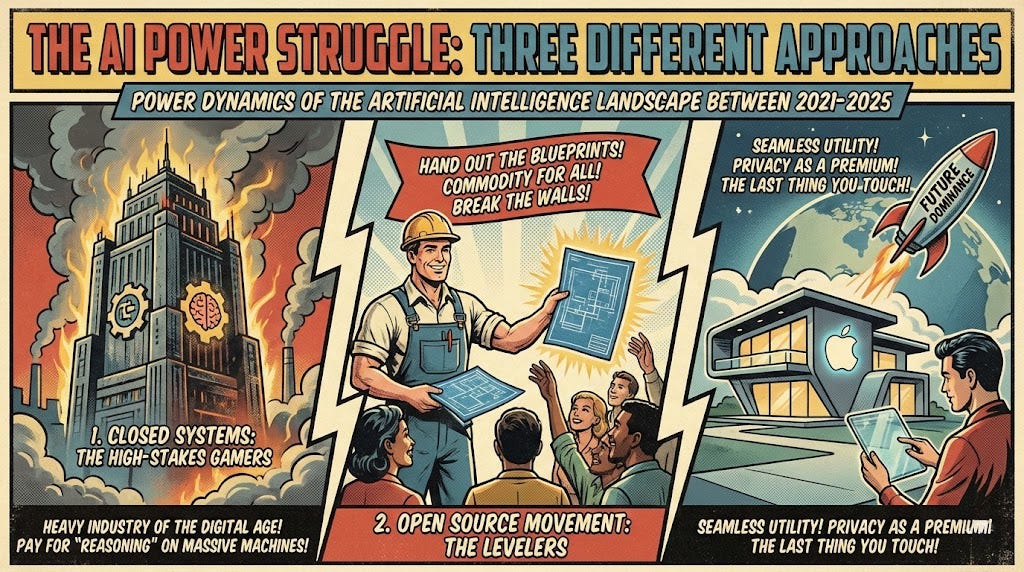
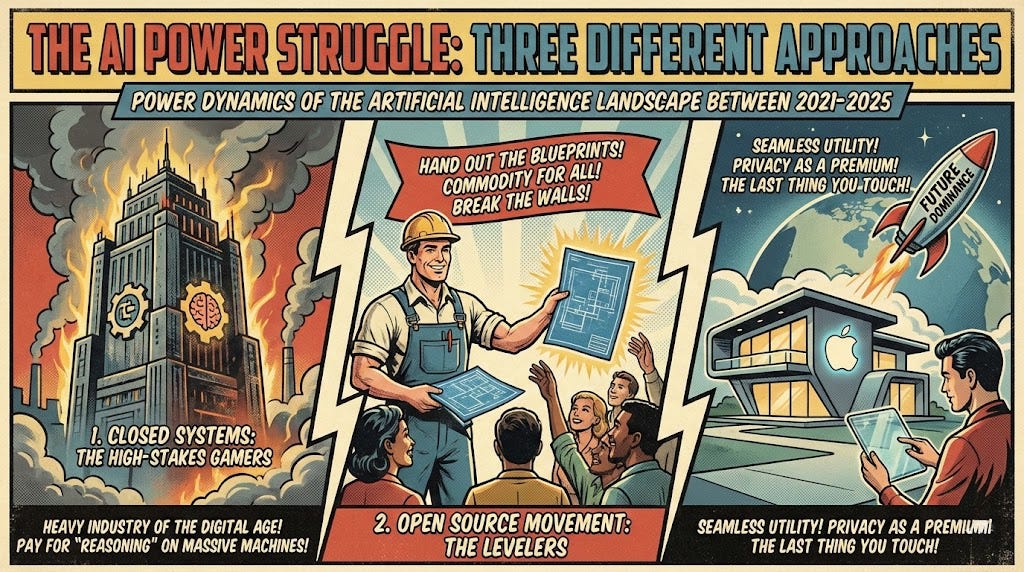
Between 2021 and 2025, this wasn’t just some technical evolution. It was a gold rush that turned into a permanent occupation. AI stopped being a novelty and became the floor everyone has to walk on. The players on the field have split into three camps, and each one is betting their entire existence on a different version of the future.
1. The Closed Systems: The High-Stakes Gamers
Primary Players: OpenAI, Google, Anthropic.
These people are operating on a scale that most of us can’t even comprehend. They are the heavy industry of the digital age. Over the last four years, they’ve burned through billions of dollars in capital for one reason: to see what happens when you throw more power at the problem.
The Reality Check: OpenAI had the lead, but Google and Anthropic didn’t stay down. They spent the money, built the infrastructure, and caught up. By 2025, the game shifted. It’s no longer about a chat box giving you a list of facts. It’s about “Action.” These systems now operate your hardware. They write the code and execute it in real-time. They aren’t talking anymore; they are doing.
The Future (2026–2028): Simple text generation is going to be free because it’s no longer difficult. These companies will instead charge you for “Reasoning.” You’ll pay for the time the machine spends processing a complex problem. To survive, Google is building its own chips, and OpenAI is trying to build its own power grid and server farms to stop paying everyone else’s profit margins.
2. The Open Source Movement: The Levelers
Primary Players: Meta, DeepSeek.
While the big players tried to build walls, these guys decided to hand out the blueprints. They’ve turned what was supposed to be a proprietary advantage into a commodity that anyone can use.
The DeepSeek Shift: In 2025, everything changed. A Chinese firm proved you could build a high-level system for five million dollars instead of a hundred million. That effectively ended the argument that only the wealthiest companies could compete.
The Strategy: Meta isn’t doing this to be kind. They are doing it so Google and Microsoft can’t charge them for the tools they need to run their business. By making the foundation free, they ensure they stay in control of their own house.
The Future (2026–2028)
This is where the privacy-conscious and the corporations go. They’ll run these models on their own hardware, behind their own firewalls. You’re going to see specialized hardware designed specifically to run these open-source architectures at high speeds on local devices. The “cloud” isn’t the only destination anymore.
3. Apple: The Integration Play
Primary Player: Apple.
Apple doesn’t care about being first. They care about being the last thing you touch before you go to sleep. They don’t view this technology as a product; they view it as a utility, like the wiring in your walls.
The Approach: They aren’t trying to build the smartest machine in the world. They’re trying to build the most useful one. While everyone else is obsessed with the model, Apple is focused on the interface. They want the machine to handle your emails and your calendar without you ever having to think about the underlying technology.
The Privacy Angle: They are betting that eventually, you’ll get tired of every other company looking at your data. They’re positioning themselves as the only ones who will give you these tools without recording your private life.
The landscape is settled. The lines are drawn. Now we see who has the endurance to stay in the game.