

The High Cost of Certainty: Embracing "I'm Not Sure"
How Options Sellers Quantify Doubt to Avoid Catastrophic Conviction and Price Risk

Certainty is an Expensive Illusion: The pressure to project absolute conviction in markets breeds overconfidence and intellectual rigidity which inevitably leads to oversized positions and catastrophic losses.
Trade Prediction for Probability: Successful options selling requires a shift from trying to predict the market’s direction to quantifying the probability of outcomes, turning trading into a statistical business model.
Uncertainty is Your Risk Governor: Embracing uncertainty tactically informs all trading mechanics, setting low-probability strike prices and acting as a natural governor for position sizing.
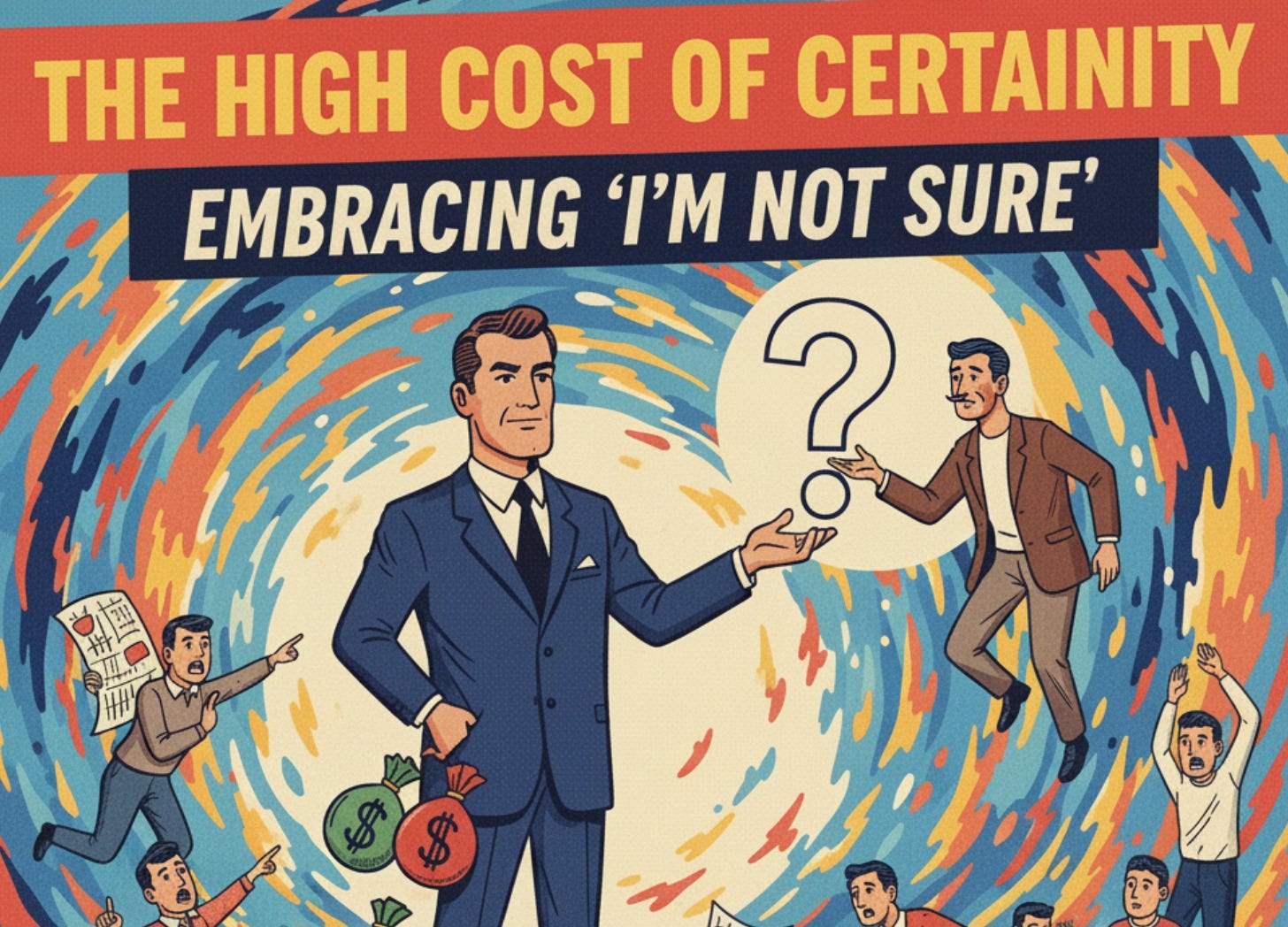
In this miserable arena of finance, everyone’s a goddamn mercenary performer. YouTube, TikTok, Twitch influencers have everyone grasping at the fleeting validation of likes, follows, and whatever digital barnacle term happens to be coined this quarter. All are prophesying a bulletproof façade of easy money as absolute conviction.
The culture demands it.
The trader who acts like they know everything gets the spotlight and is welcomed into the darkest parts of our greedy hearts. It’s an act, a dishonest game where analysts are forced to trade genuine nuance for the illusion of infallibility.
This is where the real trouble starts. That pressure to be certain breeds a false sense of security, not just for the gullible audiences, but for the one pulling the trigger. It’s a poison that turns into overconfidence and…pause for effect…overconfidence is the most expensive mistake you can make in a market that’s a chaotic animal. You get rigid. You stop listening. The overconfident trader oversizes their position, ignores the screaming warning signs, and inevitably gets smoked when the market proves their “certainty” was a lie.
Here’s the truth: saying “I’m not sure” is not a weakness. It’s the declaration of a professional who actually understands the complexity of the job. It’s intellectual honesty. Embracing that uncertainty gives you the flexibility to adapt, to shed the biases, and to adopt the probabilistic mindset that keeps you alive. The honest trader accepts the doubt; the fool chases absolute certainty.
1. “Works in Progress.” Beliefs are Tentative
Here’s the thing, the market doesn’t give a damn about your thesis. It’s a relentless feed of new data and if you can’t digest that data and adjust then you’re dead. The effective options seller demands a psychological shift. Treat every belief as a “work in progress.” This includes—and is not limited to—earnings, technical charts, macro signals, etc. It’s a hypothesis and nothing more. Always be ready to be ripped up and rewritten.
This framework is your barricade against “catastrophic conviction.” That’s the intellectual sickness that makes people cling to a losing trade. It’s the rigidity that blinds a trader to the contradicting evidence sitting right in front of them.
Don’t be Trader Schmuckatelli
Trader Schmuckatelli will rationalize, double down, and ignore the facts just to protect his fragile ego. That inevitably leads to outsized, high-risk positions because he thinks he knows the ending and can disregard the rules.
Shed the ego. View your beliefs as temporary. That restores intellectual humility. It allows you to seamlessly integrate an unexpected Fed announcement or the break of a key support level without having an existential crisis.
The successful options seller doesn’t have the “right” answer. They have the most adaptable, least brittle risk-management framework.
That’s the only thing that matters.
2. Shift to Probabilistic Thinking
Forget predictions. That’s for amateurs and fortune-tellers. Options trading is not about knowing where the stock will go. It’s about estimating the probability of where it won’t go. The trader trying to predict the direction is engaging in a subjective gamble and taking on reckless directional risk.
The smart money flips the question. Instead of seeking certainty, they quantify their uncertainty.
The only operative question is: “How unsure am I that this stock won’t move past this specific strike price by expiration?”
This immediately shifts the focus from a single outcome to a distribution of possibilities.
This probabilistic assessment, calibrated with volatility and historical data, is the foundation of sound risk management. It defines the safe range and favorable risk-reward zone. It provides the objective criteria for setting appropriate strike prices, dictating sane position sizing, and establishing the exit rules before the trade is ever put on.
You’re Not Gambling
You’re Running a Quantified, Statistical Business Model
3. Estimating Uncertainty for Trade Mechanics
The abstract concept of uncertainty has to be put to work by informing the core mechanics of options selling. The quantified probabilistic assessment (i.e., your measured understanding of how unsure you are) provides the precise data you need to manage risk and collect premium.
Your strike selection becomes an unemotional process. You choose strikes statistically far enough away to represent a low probability of being breached.
That’s your edge: you get paid for accepting a low-probability risk.
More importantly, this assessment is the natural governor of position sizing. If the perceived uncertainty is high, the trade size must be small. Uncertainty caps exposure, ensuring that no single high-risk position can catastrophically damage the portfolio. You adhere to the law of large numbers by ensuring that high-volatility, high-uncertainty trades are small and manageable shots. When a trade hits a statistical failure point your defined risk plan is automatically triggered which safeguards your capital. It’s a cold, statistical process.
4. Uncertainty as a Tool for Credibility
The benefits of uncertainty aren’t just internal. They’re interpersonal. A trader who speaks with candor moves past the pathetic language of “I know” to the responsible framing of a potential trade: “I believe X will happen, but I assign a 15% chance to Y because of factor Z.”
This nuanced approach instantly makes traders more credible communicators. In a world of financial showmen making baseless predictions, acknowledging analytical limits builds trust. It tells people you’re running a thoughtful, probabilistic framework, not relying on a hunch.
Furthermore, this honest approach fosters collaboration. Certainty is a conversation killer. It makes any challenge feel like a hostile confrontation. Expressing a specific, estimated probability invites your colleagues to weigh in and suggest a factor that changes your 15% tail risk. This collective scrutiny leads to a far more robust risk assessment. By socializing the uncertainty, the group identifies the blind spots that would sink a lone “expert.”
5. The Value Proposition of “I’m Not Sure” in Options Selling
Acknowledging uncertainty is not just a polite way to speak. It’s the fundamental mathematical engine of options selling. The market itself is designed to price the unknown. When you sell an option, you are collecting a premium—a known, tangible payment—for accepting a defined risk rooted in a fundamentally unknown future.
The true cost of certainty is what the confident, directional fool pays: Trader Schmuckatelli takes on excessive, unjustified risk because he’s convinced he knows the outcome. When he’s wrong, the damage is often terminal and written off as unlucky.
Final Thoughts
The profit for the disciplined options seller is built on their comfort with being “not sure.” Their methodology is simple: calculate the odds, set the strikes based on low probability, and size the trade to manage that risk. They aren’t predicting. They are pricing risk. By consistently accepting a small, manageable probability of loss, the seller exploits the long-term inefficiency created by the market’s desire to pay for certainty. The reward is a high-probability, positive-expectancy strategy driven entirely by professional humility.